
Things To Do
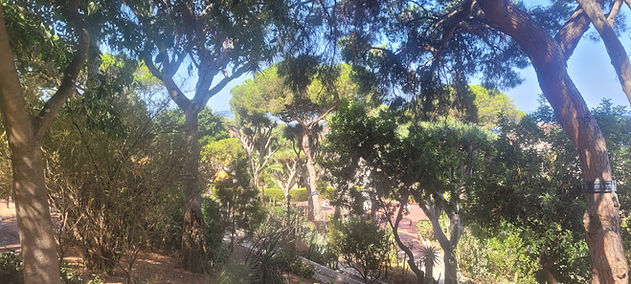
Alameda Gardens
Public Gardens
The Alameda Gardens opened to the public in 1816. The gardens are home to many plants and trees, which make the Alameda such a magical place; most are native species, while others are imported. Some of these plants date back to the opening, so are at least 200 years old.
There are many monuments within the gardens, but pride of place goes to the General Elliot Column and the impressive bronze ordnance at its feet. At the main gate by the grand parade car park, there are aksi are two of the four Russian guns given to Gibraltar by Britain, for Gibraltar’s help during the Crimean War, in 1858.
The gardens are also home to Gibraltar's park run every Saturday. You can find more information on that here.

Dolphin Watching
Wildlife Watching
It's not just the rock itself which is full of wildlife; the Bay of Gibraltar is too!
The Bay of Gibraltar is thought to be one of Europe's richest marine environments, and is home to our iconic wild bottlenose dolphins year-round, perhaps Gibraltar's most charismatic inhabitants.
It's not just bottlenose dolphins, though the Bay of Gibraltar is also home to the common dolphin and the striped dolphin. All these dolphins make the area popular for wildlife watching!

Europa Point
Viewpoint
Europa Point refers to the area around the southern most tip of Gibraltar, providing some of the most spectacular views in the Mediterranean, with Africa visible across the narrow Strait of Gibraltar on a clear day. The last time the strait opened up was around five million years ago, when Europe separated from Africa.
The areas unique microclimate supports specialized plant communities, including several endemic species found nowhere else in the world, such as the Gibraltar Sea Lavender (Limonium emarginatum). Due to Gibraltar's position on bird migratory routes the area also serves as a vital stopover point for migratory birds traveling between the continents.

Europa Point Lighthouse
Museum
49 meters above sea level, the Europa Point lighthouse is the only Trinity-operated lighthouse outside the British Isles. Standing at 19 meters tall. In Llanito, it is known affectionately as "la farola" or Victoria Tower.
Before the lighthouse's construction, the only guiding light in the area was that from the Shrine of Our Lady of Europe, a Roman Catholic shrine. Though originally built as a mosque. This, unsurprisingly, caused problems for ships trying to navigate through the straits and the bay of Gibraltar, most commonly with a group of jagged rocks on the western side of the Gibraltar Bay, known as the Pearl Rock.

Mediterranean Steps
Walking Trail
Mediterranean Steps is a steep, at times arduous, walk and is not for people without a head for heights. Early mornings are usually preferable, but during the summer months a late afternoon walk will provide the visitor with plenty of much-needed shade. The area is particularly appealing during the spring, when the visitor is greeted by an interesting and very beautiful array of flowers. Mediterranean Steps take the walker from Jews’ Gate on the southern end of the Nature Reserve at 180m above sea level, up towards O’Hara’s Battery at 419m, close to the summit of the Rock.

National Museum
Museum
Established in 1930 by the then Governor of Gibraltar, General Sir Alexander Godley, the Gibraltar National Museum houses an array of displays portraying the Rock's millennia-old history and the unique culture of its people. The museum also incorporates the remains of a 14th-century Moorish bath house adjacent to its main exhibition building.
The site houses an open-air archaeological exhibit of an excavation spanning seven centuries of Gibraltar’s history. Fourteenth-century well; sixteenth-century cistern and nineteenth-century water channels. Along with the aforementioned remains of Moorish Baths.

Natural History Museum
Museum
The Natural History Museum at Parsons' Lodge represents the next step in the expansion of Gibraltar’s heritage showcase, in a setting of both ecological and historical importance.
The site (Parsons Lodge) has a strategic position, making it a staging post for migratory birds moving between Africa and Europe; and its proximity to the coastline gives it added value in terms of marine and intertidal biology.